9 apps $14.99/moSee package
← Back to Best Shopify Apps

Best Shopify SEO Apps 2026

Best Shopify SEO Apps 2026 — Technical Auditing, Structured Data, Page Speed & Meta Tag Automation Ranked

Last updated: July 2026 · Pricing verified July 2, 2026 · Reviewed by the Libautech team, builders of Bundles & Upsell, Sticky Add to Cart, Announcement Bar, and 7 other Shopify apps used by 5,000+ merchants across 50+ countries.

Key Takeaways

  • SEO apps for Shopify cover four distinct jobs: technical site auditing (broken links, missing meta tags, redirect chains), structured data injection (JSON-LD schema for rich results and AI Overview citations), page speed optimization (image compression, WebP conversion, lazy loading for Core Web Vitals), and on-page meta tag automation (titles, descriptions, alt text at scale across thousands of pages). Most stores need one app that covers two or three of these jobs rather than four separate tools.
  • Paid ad costs on Meta and Google rose 22% year-over-year in 2025. Stores ranking page one for commercial-intent keywords pay 4-6x less per customer acquired than those running equivalent paid campaigns. The merchants who held their margins through the rising-CAC environment did so with organic traffic, not by spending more on paid.
  • Google's 2025-2026 core updates leaned harder into structured data, E-E-A-T signals, and Core Web Vitals. Stores that had schema markup and compressed images in place before those updates saw traffic hold; stores that did not saw double-digit drops. Structured data has become particularly material because it now drives both Google rich results and citations in Google AI Overviews, ChatGPT, and other AI search systems.
  • Avada SEO & Image Optimizer leads the category with 4.9 stars across 7,500+ reviews as the most-reviewed SEO app on the Shopify App Store. Plug In SEO for prioritized issue scanning, Smart SEO for multilingual meta tag automation at $9.99/mo (lowest paid price), JSON-LD for SEO for structured data specifically, and Tiny for page speed and image compression are the strongest specialists.
  • Page speed improvements (image compression, WebP conversion, lazy loading) typically show measurable ranking impact within 2-4 weeks because Core Web Vitals affects every page simultaneously. Meta tag and title optimization take 4-8 weeks to show ranking impact. Structured data and rich results typically appear in search within 2-6 weeks of implementation.
  • SEO apps pair well with conversion tools rather than replacing them. The honest stack for most stores is one SEO app plus Libautech's Bundles & Upsell, Sticky Add to Cart, and Announcement Bar on the $14.99/mo Package plan. SEO drives organic traffic to product pages; the conversion stack lifts AOV and conversion rate on the resulting site visits.

The Four Jobs of Shopify SEO Apps

"SEO app" is a loose category covering four distinct jobs that share the goal of improving organic search performance but differ completely in implementation, maintenance burden, and ranking impact timeline. Most SEO app comparisons treat these jobs interchangeably, which produces misleading recommendations because an app that excels at image compression often falls short on structured data, and vice versa. The right choice depends on which job is actually material to the store.

The first job is technical site auditing. The threat: stores accumulate technical debt over time. Broken links from product deletions, duplicate meta titles across similar variants, missing alt text on images, redirect chains from URL changes, and pages with no meta description. Each issue is small individually, but the cumulative effect drags ranking. The fix: an app that scans the entire store, surfaces every issue with a prioritized fix list, and provides instructions for resolution. Plug In SEO and SEO Booster lead this category. The right pick depends on whether the store wants automated scanning with manual fixes (Plug In SEO) or automated scanning with auto-fix capability (SEO Booster).

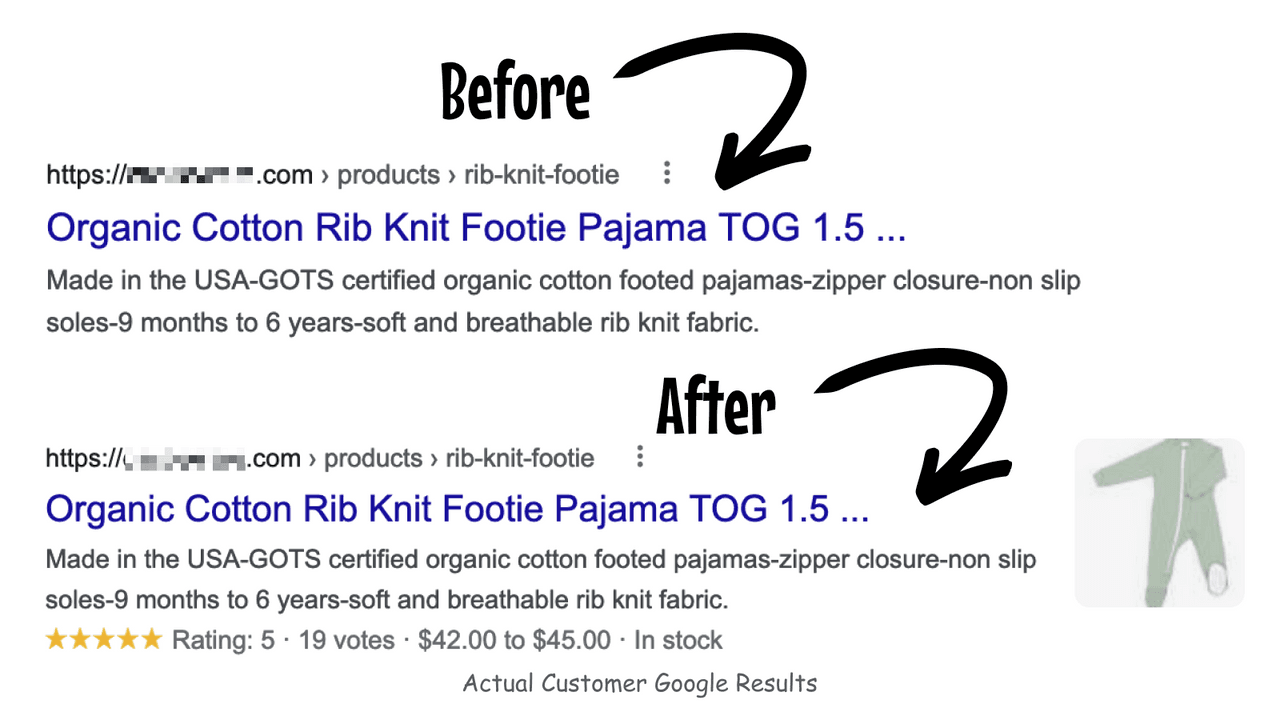
The second job is structured data injection. The threat: Google and AI systems cannot reliably extract product information (price, rating, availability, breadcrumbs) from Shopify storefronts without explicit schema markup. Without structured data, the store loses rich result eligibility and AI citation opportunities. The fix: JSON-LD schema markup injected automatically across product, collection, article, and FAQ pages. JSON-LD for SEO is the specialist; Avada and Plug In SEO include this as part of their broader feature sets. Structured data has become particularly material since 2024 as Google AI Overviews and other AI search systems extract product data from schema markup directly.

The third job is page speed optimization. The threat: Core Web Vitals (specifically Largest Contentful Paint, First Input Delay, and Cumulative Layout Shift) are direct Google ranking factors. Uncompressed product images are the number one cause of slow LCP scores on Shopify, with average product images often 5-10x larger than they need to be. The fix: automatic image compression, WebP conversion, and lazy loading. Tiny is the specialist; Avada includes image compression as part of its broader feature set. Speed improvements compound across every page simultaneously, which is what makes page speed the highest-leverage SEO investment for stores with large image catalogs.

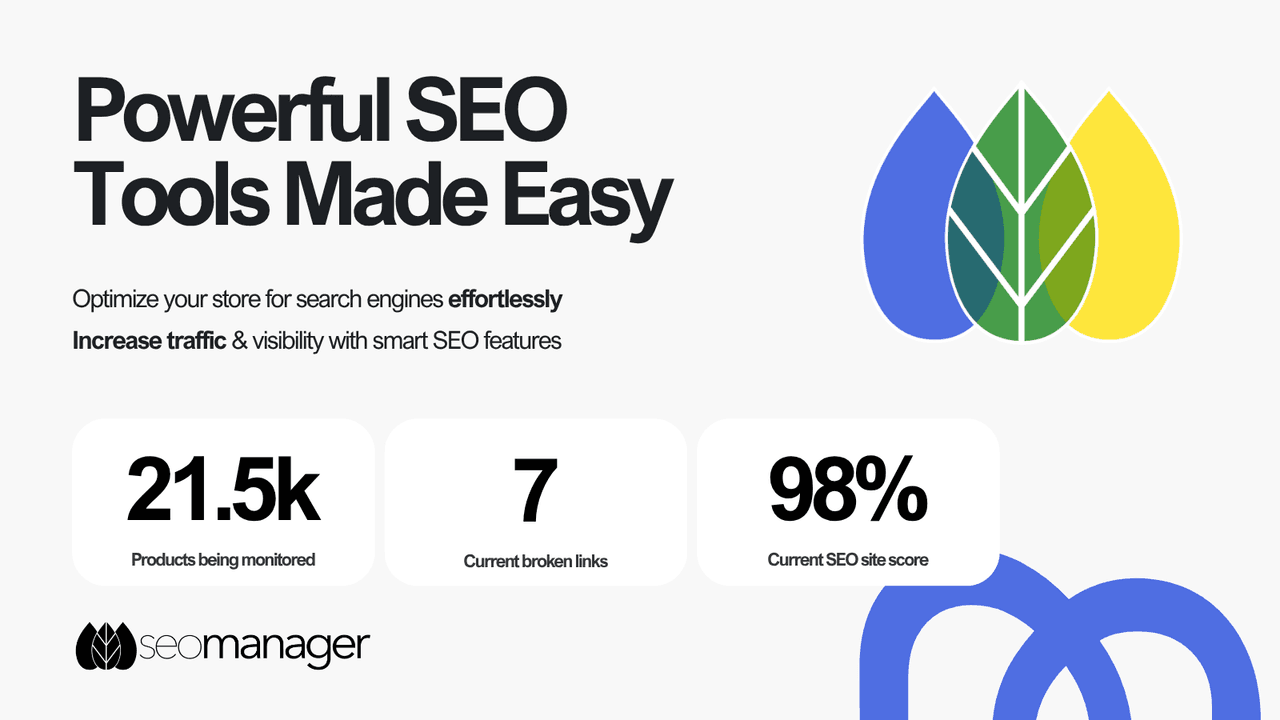
The fourth job is on-page meta tag automation. The threat: writing unique meta titles, descriptions, and alt text for every product, variant, and collection across thousands of pages is operationally infeasible without automation. Stores either skip meta tags entirely (losing search visibility) or accept duplicate templated meta tags (losing search-snippet click-through rate). The fix: template-based automation that generates unique meta tags across the catalog using product data (title, vendor, price, key attributes). Smart SEO and SEO Manager lead this category. Multilingual stores running Shopify Markets get particular value from Smart SEO's automatic meta tag translation across all store languages.

How We Ranked These Apps

This ranking is based on five criteria applied to every Shopify SEO app tested in 2026. First, Shopify App Store rating and verified review volume as of May 4, 2026. SEO apps that have accumulated thousands of reviews at 4.7+ ratings have a real track record of ranking impact across thousands of stores running the standard SEO playbook. Second, which of the four SEO jobs each app solves best (technical auditing, structured data, page speed, meta tag automation). Third, pricing structure and total cost across realistic store sizes. Flat-rate apps and per-page apps scale very differently as catalog size grows, and the math diverges meaningfully past 500 products. Fourth, Built for Shopify certification and Customer Privacy API integration depth, because SEO apps that bypass Shopify's native infrastructure often create slower page loads or duplicate canonical tags that hurt the rankings the app is supposed to help. Fifth, ranking impact timeline based on documented merchant outcomes, prioritizing apps with clear before-and-after data over apps with marketing claims alone.

Every pricing figure in this post was verified directly from the live Shopify App Store listing on May 4, 2026. SEO app pricing structures change frequently as Google's algorithm and the AI search landscape evolve, so always confirm current pricing on the official listing before installing. Ratings and review counts reflect the Shopify App Store at the time of our last update.

1. Avada SEO & Image Optimizer

Rating: 4.9/5 across 7,500+ reviews · Pricing: Free plan, paid from $34.95/mo · Best for: Stores wanting one app to cover SEO fundamentals (image compression plus meta tags plus structured data) without managing multiple specialists · Job solved: Multi-job all-in-one covering page speed, meta tags, and structured data

Avada is the highest-reviewed SEO app on the Shopify App Store with over 7,500 ratings at 4.9 stars, the largest install base by review volume in the category by a significant margin. The positioning: rather than specializing in one of the four SEO jobs, Avada combines image compression, meta tag generation, structured data injection, and broken link detection in one dashboard. For stores that want to install one app and cover the SEO fundamentals without coordinating multiple specialists, Avada is the right pick because the consolidated approach reduces vendor coordination overhead.

Core features: automatic image compression on upload reducing average page load time by 30-40% on stores with large product catalogs; WebP conversion preserving visual quality at smaller file sizes; meta title and description generation across products, collections, and articles; JSON-LD schema injection for products, collections, articles, breadcrumbs, and FAQ; broken link detection with one-click 301 redirect creation; alt text automation for product images; sitemap optimization beyond Shopify's native sitemap; and a free plan covering basic image optimization and meta tags for up to 50 pages. Where it falls short: Avada does not offer deep keyword research or rank tracking. It is an on-page optimization tool, not a search analytics platform. For ranking visibility data, pair with Google Search Console or SEO Booster's rank tracking. The free plan limits cap small stores quickly, with paid plans starting at $34.95/mo. The interface has more options than simpler alternatives and takes longer to configure fully.

2. 404/301 URL Redirects by Nabu (Nabu Redirect Manager)

Rating: 4.8/5 across 44 reviews · Pricing: Free plan, paid from $7.99/mo · Best for: Stores that have renamed products, reorganized collections, or migrated from another platform (WooCommerce, BigCommerce) to Shopify and need to catch 404s and route them before broken links cost them rankings · Job solved: 404 detection and 301 redirect creation to preserve SEO equity

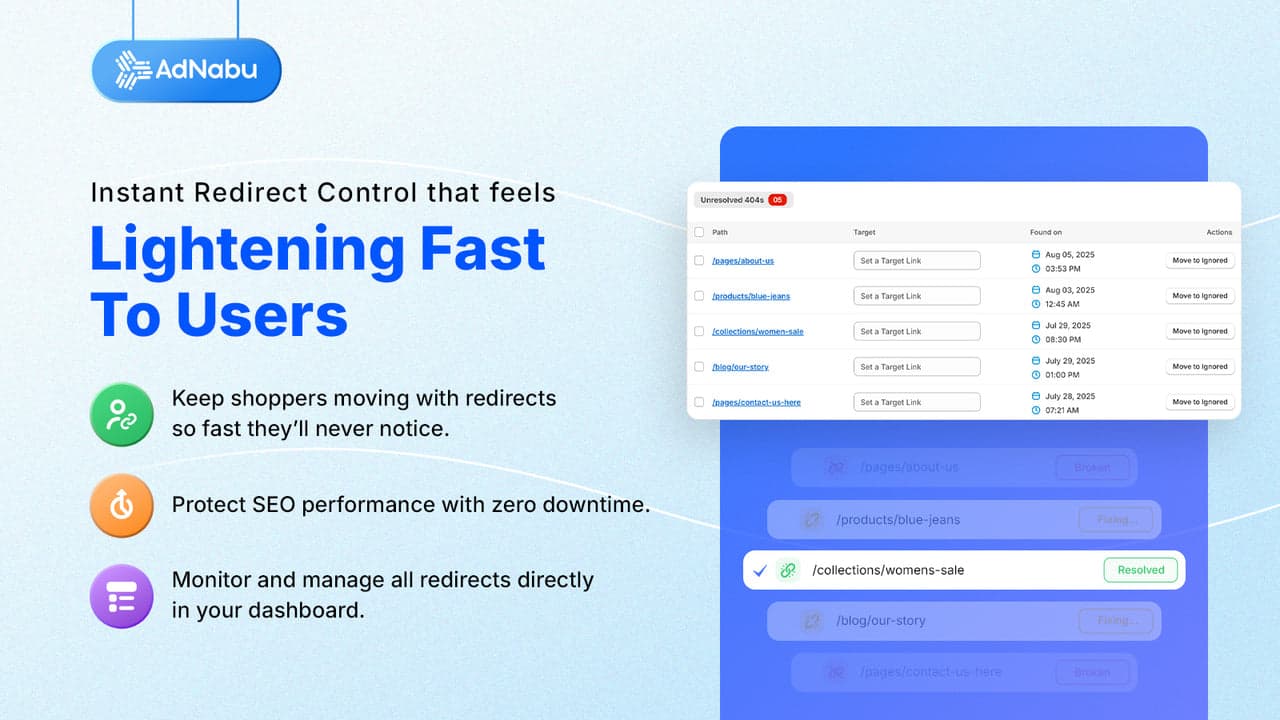
Broken URLs are the quiet ranking drain on Shopify. Products go out of stock, collections get restructured, themes change, and migrations leave behind hundreds of dead links that send both visitors and Googlebot into 404 dead ends, draining the link equity each page earned over time. Nabu Redirect Manager is built for exactly this job. It logs every 404 the moment a visitor hits one, surfaces the broken links on a single dashboard, and lets you route each one to the right page with a one-click 301 redirect. The app is Built for Shopify certified and syncs two ways with Shopify’s native redirects, so rules created in the app live inside Shopify’s own infrastructure rather than a parallel system that conflicts with it.

Core features: automatic real-time 404 detection that logs every broken URL into an Unresolved 404s list with no manual scanning; one-click 301 redirects that sync directly to Shopify; two-way sync that keeps the app and Shopify admin consistent; wildcard redirects that catch many broken URLs following a pattern with a single rule; RegEx redirects with full pattern support for advanced one-to-many routing; an AI RegEx Wizard that turns a plain-English description into a valid pattern with no code; unlimited CSV import and export for bulk management and migrations; and a free plan covering unlimited link detection, unlimited standard redirects, bulk CSV, plus up to three wildcard or RegEx rules. Where it falls short: it is a dedicated redirects tool, so stores with broader SEO needs will pair it with an app for meta tags, images, and structured data, and its review base is still growing. Best fit for stores actively managing URL changes where redirect handling is the primary need and pattern matching saves hours over building redirects one at a time. The Advanced plan at $7.99/mo adds unlimited wildcard redirects, the AI RegEx builder, and priority support.

3. Plug In SEO

Rating: 4.7/5 across 3,000+ reviews · Pricing: Free plan, paid from $29.99/mo · Best for: Stores that want a prioritized list of SEO issues to fix rather than automatic changes to their store · Job solved: Technical site auditing with prioritized issue detection

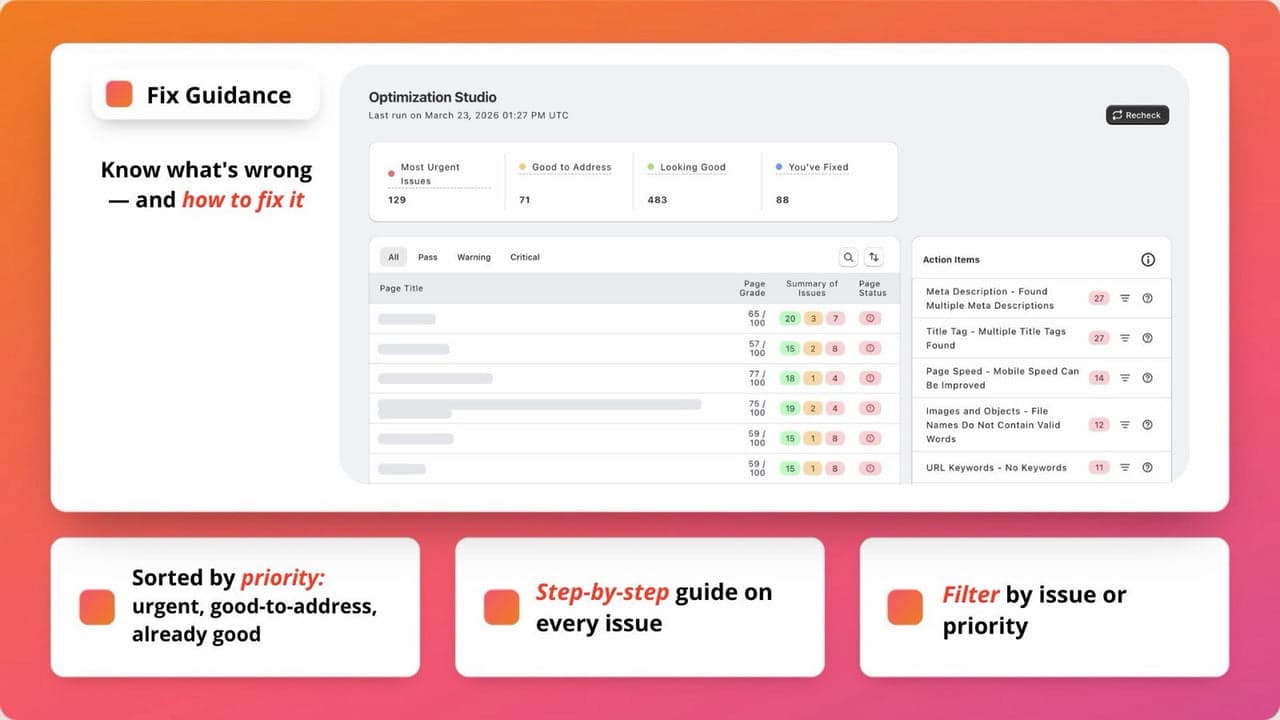
Plug In SEO is the technical auditing specialist. Rather than making automatic changes, it scans the entire store and produces a prioritized list of issues ranked by ranking impact: missing meta tags, broken links, slow-loading pages, duplicate content, missing alt text, and header structure problems. For stores that want visibility into what is wrong and control over what gets fixed, Plug In SEO is the right pick because it surfaces the full issue list without touching the store until the merchant decides to act.

Core features: full-store SEO audit scanning meta tags, headings, broken links, page speed, structured data, and content issues; prioritized fix list ranked by estimated ranking impact; step-by-step fix instructions for each issue; ongoing monitoring with email alerts when new issues appear; keyword tracking on higher tiers; and a free plan offering one full store audit per week. Where it falls short: Plug In SEO surfaces issues but does not auto-fix most of them, so the merchant still does the implementation work. Stores wanting hands-off automation should look at SEO Booster instead. The free plan's once-weekly audit is enough for monthly auditing but not for stores making frequent changes.

4. Smart SEO

Rating: 4.9/5 across 1,300+ reviews · Pricing: Paid from $9.99/mo · Best for: Multilingual stores and budget-conscious merchants needing meta tag and structured data automation at the lowest paid price point · Job solved: On-page meta tag automation with multilingual support

Smart SEO is the cost-efficient meta tag automation specialist at $9.99/mo, the lowest paid price in this list. It generates meta titles, descriptions, and alt text across the catalog automatically, and injects JSON-LD structured data. Its standout strength is multilingual support: for stores running Shopify Markets across multiple languages, Smart SEO automatically generates and translates meta tags across every store language, which is operationally infeasible to do by hand.

Core features: automatic meta title and description generation across products, collections, blog posts, and pages; JSON-LD structured data injection for rich results; automatic alt text generation for images; multilingual meta tag generation and translation across all Shopify Markets languages; bulk editing tools; and 404 error monitoring. Where it falls short: Smart SEO focuses on meta tags and structured data, so it does not offer the deep image compression of Tiny or the rank tracking of SEO Booster. It is a meta tag specialist, not an all-in-one, and stores needing page speed work should pair it with a dedicated image optimizer.

5. SEO Manager

Rating: 4.7/5 across 1,500+ reviews · Pricing: Paid from $20/mo · Best for: Stores that want meta tag management combined with broken link and 404 monitoring in a guided interface · Job solved: Meta tag management with redirect and 404 handling

SEO Manager combines meta tag editing with broken link and 404 page monitoring in one guided interface. It offers AI-assisted keyword suggestions to help optimize titles, descriptions, and meta tags, and flags 404 pages and broken links so customers do not hit dead ends. For stores that want meta tag control and redirect monitoring in a single tool with a guided setup, SEO Manager fits.

Core features: meta title and description editing with keyword suggestions; broken link and 404 page detection with alerts; Google search-result preview showing how pages appear in SERPs; structured data support; sitemap management and Google submission; and real-time SEO issue detection. Where it falls short: at $20/mo with no free plan, SEO Manager is priced above Smart SEO ($9.99/mo) while covering similar meta tag ground. Stores whose primary need is redirect handling at scale will get more from a dedicated redirects app; SEO Manager's 404 handling is monitoring-focused rather than a full pattern-based redirect engine.

6. Tiny: SEO, Speed & Image Optimizer

Rating: 4.9/5 across 2,100+ reviews · Pricing: Free plan, paid from $19/mo · Best for: Stores with large image catalogs where page speed and Core Web Vitals are the primary SEO bottleneck · Job solved: Page speed optimization through image compression

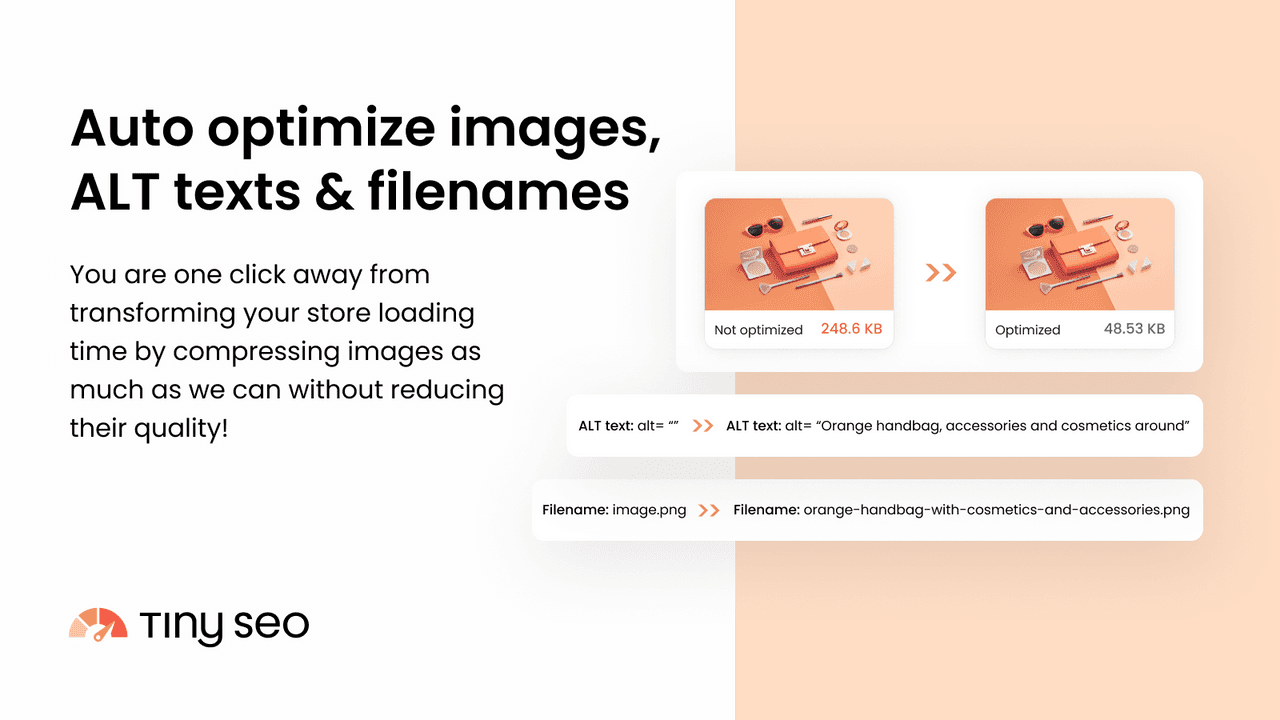
Tiny is the page speed specialist. Its core job is compressing product images, converting them to WebP, and adding lazy loading to improve Core Web Vitals scores, which are direct Google ranking factors. For stores with large image catalogs where slow LCP scores are dragging rankings, Tiny is the right pick because image weight is the number one cause of slow Shopify page loads and Tiny attacks it directly.

Core features: automatic image compression reducing file sizes by up to 70% without visible quality loss; WebP conversion; lazy loading for images below the fold; JSON-LD structured data; IndexNow integration for faster indexing; alt text automation; broken link detection; and a free plan covering a set number of image optimizations per month. Where it falls short: Tiny's free plan caps image optimizations, so large catalogs hit the ceiling quickly and need a paid plan starting at $19/mo. Its meta tag and structured data features are solid but secondary to its image compression focus; meta-tag-first stores may prefer Smart SEO.

7. JSON-LD for SEO

Rating: 4.9/5 across 500+ reviews · Pricing: Paid from $12.99/mo · Best for: Stores prioritizing rich results and AI search citations through comprehensive structured data · Job solved: Structured data injection for rich results and AI visibility

JSON-LD for SEO is the structured data specialist. While many all-in-one apps include basic schema, this app focuses entirely on comprehensive, correctly-formatted JSON-LD markup across every page type. For stores prioritizing rich results in Google and citations in AI search systems, the specialist depth matters because malformed or incomplete schema is a common reason stores miss rich result eligibility.

Core features: comprehensive JSON-LD schema for products, collections, articles, breadcrumbs, FAQ, search box, and organization; automatic schema updates when products change; rich result eligibility for star ratings, prices, and availability in search; schema validation; and support for the schema types that Google AI Overviews and other AI systems extract product data from. Where it falls short: JSON-LD for SEO does one job. It does not compress images, generate meta tags, or track rankings. It is designed to be stacked with a meta tag app and an image optimizer, not used alone. For stores wanting one app to cover everything, an all-in-one like Avada is a better starting point.

8. SEO Booster

Rating: 4.8/5 across 2,600+ reviews · Pricing: Free plan, paid from $39/mo · Best for: Stores that want rank tracking combined with automated SEO issue fixing in one tool · Job solved: Technical auditing with auto-fix plus rank tracking

SEO Booster combines technical auditing with automatic issue fixing and built-in rank tracking, which most SEO apps leave to Google Search Console. It scans the store, auto-fixes many common issues, and tracks keyword rankings over time so merchants can see the ranking impact of their SEO work in one dashboard. For stores that want auto-fix plus rank visibility without stacking a separate analytics tool, SEO Booster fits.

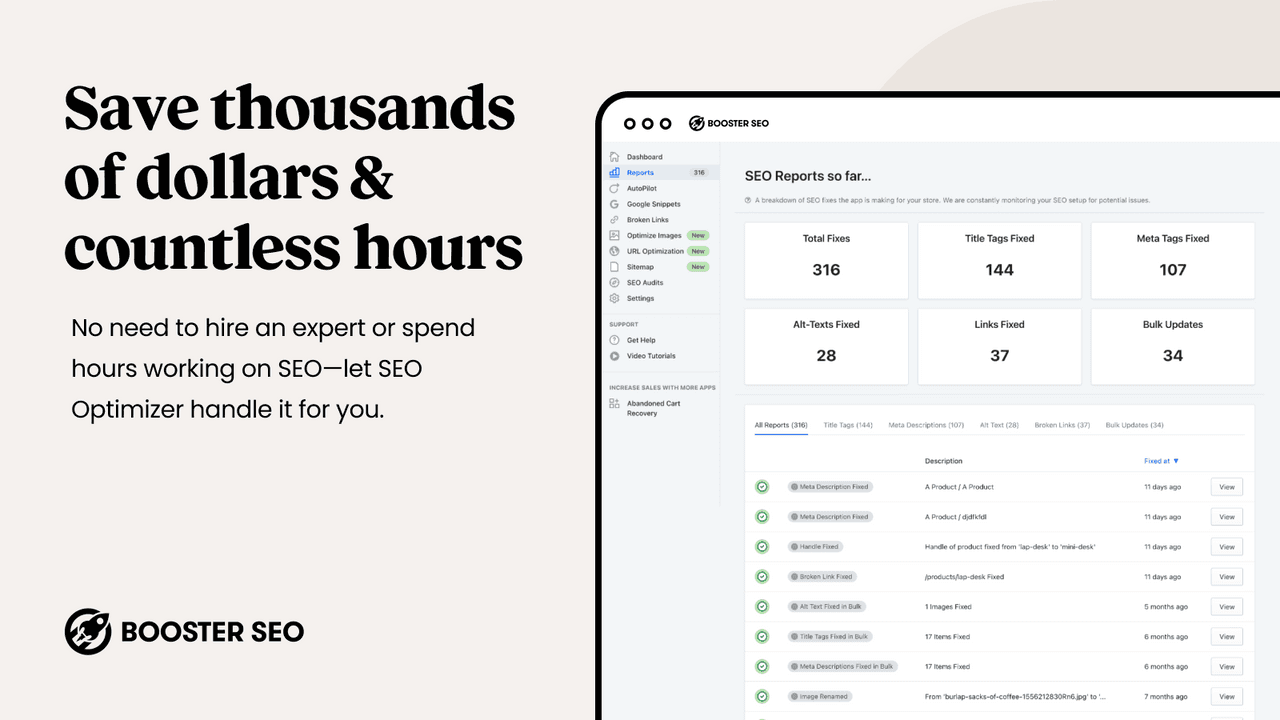
Core features: automated SEO issue scanning with one-click and auto-fix for common problems; built-in keyword rank tracking; meta tag optimization; image optimization and alt text; structured data; Google Search Console integration; and a free plan covering basic optimization. Where it falls short: at $39/mo, SEO Booster's paid tier is the most expensive in this list, reflecting the added rank tracking. Stores that already use Google Search Console for rank data may be paying for overlap. The auto-fix is convenient but stores wanting full control over every change may prefer Plug In SEO's surface-and-review approach.

9. Booster SEO Image Optimizer

Rating: 4.8/5 across 1,200+ reviews · Pricing: Free plan, paid from $24.99/mo · Best for: Mid-market stores wanting all-in-one SEO coverage at a price point between the specialists and Avada · Job solved: Mid-tier all-in-one covering meta tags, images, and structured data

Booster SEO Image Optimizer is a mid-market all-in-one covering meta tag automation, image compression, and structured data at $24.99/mo, positioned between the single-job specialists and Avada's higher-tier pricing. For mid-market stores wanting broad coverage in one app without configuring multiple specialists or paying Avada's $34.95/mo, Booster is the middle-ground pick.

Core features: bulk meta title and description optimization; image compression and alt text automation; JSON-LD structured data; broken link and 404 detection; SEO issue scanning; and a free plan covering basic optimization. Where it falls short: as an all-in-one, Booster does not match the depth of the specialists in any single job. Tiny compresses images more aggressively, JSON-LD for SEO handles structured data more comprehensively, and Smart SEO automates meta tags at a lower price. Booster is a generalist, best for stores that value one-app simplicity over best-in-class depth in any one area.

Comparison Table: 10 Best Shopify SEO Apps (2026)

AppJobRatingPricingBest ForAvada SEO & ImageMulti-job all-in-one4.9/5 (7,500+)Free, $34.95/moMost-reviewed all-in-one404/301 URL Redirects by NabuRedirects & 404 management4.8/5 (44)Free, $7.99/moDedicated redirect + pattern matchingPlug In SEOTechnical auditing4.7/5 (3,000+)Free, $29.99/moPrioritized issue scanningSmart SEOMultilingual meta tags4.9/5 (1,300+)$9.99/moLowest-cost meta automationSEO ManagerRedirect management4.7/5 (1,500+)$20/moMigration redirect handlingTiny: SEO & SpeedPage speed optimization4.9/5 (2,100+)Free, $19/moImage compression specialistJSON-LD for SEOStructured data4.9/5 (500+)$12.99/moRich results + AI OverviewsSEO BoosterRank tracking + auto-fix4.8/5 (2,600+)Free, $39/moCombined rank trackingBooster SEO ImageMid-tier all-in-one4.8/5 (1,200+)Free, $24.99/moMid-market price pointShoptankAI search visibility (AEO/GEO)New7-day trial, $14.99/moTracking ChatGPT, Claude & Perplexity

Picking the Right SEO Stack by Store Profile

The decision tree is shaped by which SEO job is actually material to the store. Small stores under $50K/month with under 100 products: Tiny free plan plus Smart SEO at $9.99/mo covers page speed and meta tags for roughly $10/mo total. Mid-market stores from $50K to $500K/month: Avada or Booster as the all-in-one base, adding JSON-LD for SEO if structured data and AI citations are a priority. Stores over 500 products or running frequent migrations: add 404/301 URL Redirects by Nabu for redirect handling at scale so URL changes never leak ranking equity. Multilingual stores on Shopify Markets: Smart SEO for automatic meta tag translation is close to non-negotiable. Stores that want rank visibility in one dashboard: SEO Booster at $39/mo folds rank tracking into the SEO app rather than running a separate analytics tool.

The common mistake is installing three or four overlapping all-in-one apps, which stacks duplicate schema and meta tag logic, slows the store with redundant scripts, and can create conflicting canonical tags. Pick one all-in-one or one primary specialist per job, and only add a second app when there is a specific gap the first does not cover. More SEO apps is not more SEO; it is usually just more load time and more conflicts.

What Native Shopify Already Handles

Before installing anything, it is worth knowing what Shopify does natively so you do not pay for overlap. Shopify automatically generates an XML sitemap, sets canonical tags to prevent duplicate content penalties, produces a robots.txt file, and gives you editable meta title and description fields on every product, collection, page, and blog post. It also creates clean, readable URLs and handles basic mobile responsiveness through modern themes. That is the floor.

What Shopify does not handle natively: structured data beyond basic product schema, image compression and WebP conversion at scale, broken link and 404 detection, redirect management beyond manual one-at-a-time entries, multilingual meta tag automation, bulk meta tag editing across thousands of pages, and any form of SEO auditing or rank tracking. These gaps are precisely what the apps in this list fill. If your store is small and your catalog is stable, native Shopify plus Google Search Console may be enough to start. The apps earn their cost once the catalog grows, images pile up, URLs change, or you expand into multiple languages.

How SEO Apps Pair with Conversion Tools

SEO is a traffic channel, not a conversion channel. It brings qualified organic visitors to product and collection pages, but what those visitors do once they arrive is a separate problem solved by a different set of tools. The honest framing: an SEO app and a conversion app are complements, not substitutes, and the highest-ROI setup runs both. There is no point driving hard-won organic traffic to a product page that converts at 1% when small conversion-rate and AOV improvements compound against every one of those visits.

For the conversion layer, Libautech's Package plan at $14.99/mo covers Bundles & Upsell for AOV, Sticky Add to Cart for a persistent checkout path, and Announcement Bar for promotions and free-shipping thresholds. The division of labor is clean: the SEO app earns the visit, the conversion stack earns the higher-value order on that visit. Stores that invest only in SEO leave conversion revenue on the table, and stores that invest only in conversion tools run out of traffic to convert. Running both is what makes the organic channel actually pay back.

Common SEO App Mistakes

The first mistake is installing too many overlapping apps, covered above: duplicate schema, redundant scripts, conflicting canonicals, and slower pages. The second is treating SEO apps as set-and-forget. Installing an app and never returning to act on its findings produces no ranking movement; the value is in fixing what the audit surfaces, not in having the audit. The third is ignoring page speed while optimizing meta tags. A store with perfect meta tags and 6-second load times will not rank, because Core Web Vitals gates everything. The fourth is skipping structured data, which in 2026 costs both rich results and AI search citations. The fifth is expecting instant results: SEO compounds over 3-6 months, and stores that abandon the work after three weeks of flat rankings quit right before the payoff. The sixth is optimizing for search engines while writing product copy no human wants to read, which now backfires because AI systems extract and cite specific, useful product detail rather than keyword-stuffed marketing language.

SEO and AI Search: What Changed in 2025-2026

The biggest shift in Shopify SEO over the last two years is that "search" no longer means only Google's ten blue links. Google AI Overviews now sit above organic results for a large share of queries, and a growing number of shoppers start product research directly in ChatGPT, Claude, and Perplexity. These systems do not crawl and rank pages the way classic Google did; they extract structured information and synthesize answers, citing a handful of sources. That changes what SEO work matters.

The strategic implication: structured data has shifted from a nice-to-have for rich result eligibility to a requirement for AI search visibility. Stores investing in SEO in 2026 without serious structured data work are leaving meaningful traffic on the table because AI-driven search is growing faster than traditional Google Search for product discovery queries. JSON-LD for SEO is the most direct fix at $12.99/mo. Avada includes structured data as part of the broader feature set but does not match the depth of JSON-LD for SEO's specialist focus.

Beyond schema markup, AI search also rewards clear H1/H2 structure, FAQ schema specifically, and dedicated content for question-style queries (who, what, how, why, when). Stores writing product descriptions in pure marketing language ("Premium quality, exceptional craftsmanship, unmatched performance") get cited less than stores writing descriptions that answer common product questions ("This headphone has 30-hour battery life, supports Bluetooth 5.3, and weighs 250g"). The descriptive specifics are what AI systems extract and cite. Marketing language gets summarized away. The fix is writing product copy that includes the specifics customers ask about (dimensions, weight, materials, compatibility, warranty) rather than relying purely on benefit-focused marketing language.

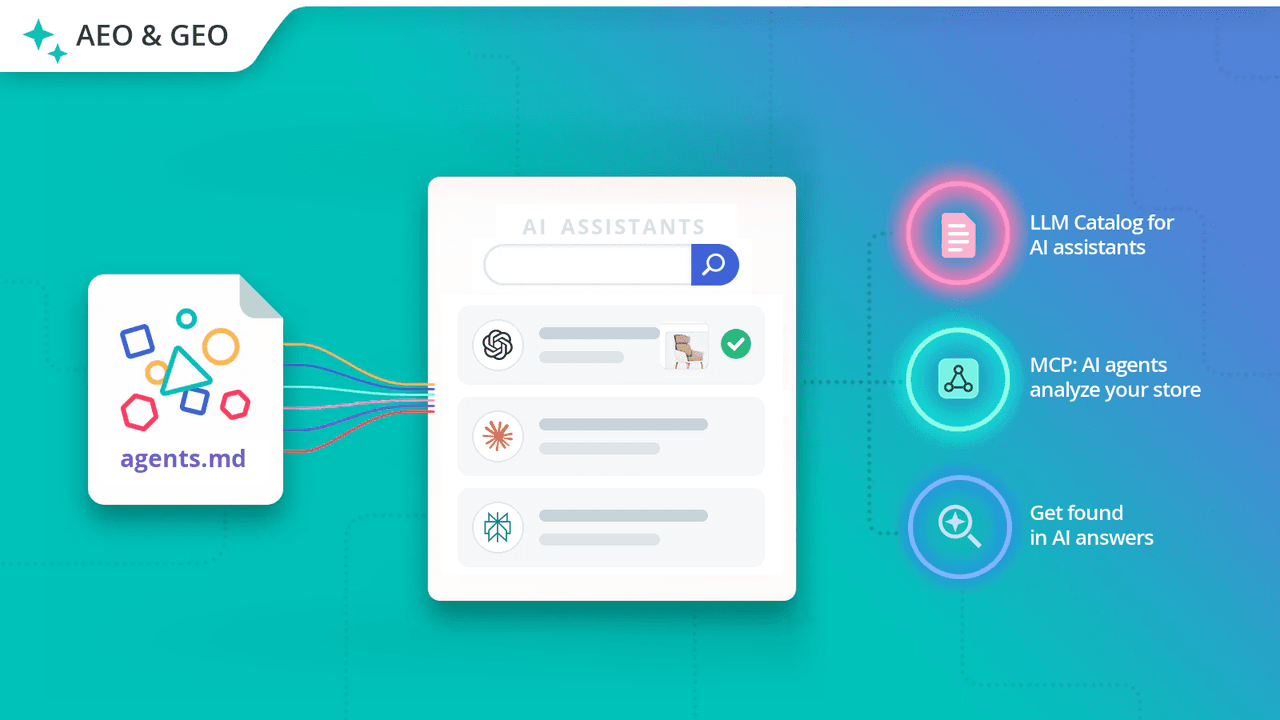
There is a second gap schema alone does not close: knowing whether AI models actually recommend you. Clean JSON-LD makes your store readable to ChatGPT, Claude and Perplexity, but it does not tell you if you appear in their answers, at what position, or which sources they pulled the recommendation from. That is a different job, and it is the one Shoptank handles. Disclosure: Shoptank is built by Libautech, the publisher of this blog. You enter the buyer-intent queries your customers actually type, for example best wireless headphones under $200, and Shoptank runs them through ChatGPT, Claude, Perplexity and the Shopify Catalog, then reports whether you appear and which Reddit threads, blog posts and videos drove the recommendation so you know exactly where to get cited. It does not replace a technical SEO app, it sits on top of one: use a schema tool like JSON-LD for SEO to become readable, then use Shoptank to measure and improve whether you are actually recommended. Shoptank starts at $14.99/mo with a 7-day free trial.

FAQ

What is the best Shopify SEO app in 2026? Avada SEO & Image Optimizer is the best overall Shopify SEO app with a 4.9-star rating across 7,500+ reviews, the most-reviewed SEO app on the Shopify App Store. It covers image optimization, meta tags, and structured data in one dashboard. For rank tracking specifically, SEO Booster at $39/mo is the better choice. For multilingual stores, Smart SEO at $9.99/mo is the cost-efficient choice.

What is the best free Shopify SEO app? Avada SEO & Image Optimizer, Plug In SEO, Tiny, SEO Booster, and Booster SEO Image Optimizer all offer free plans. Avada's free plan is the most comprehensive for basic image optimization and meta tags. Plug In SEO gives one full store audit per week free, which is enough for stores auditing monthly.

How much do Shopify SEO apps cost? Paid plans range from $7.99/mo (404/301 URL Redirects by Nabu) to $39/mo (SEO Booster with rank tracking). Most comprehensive SEO apps cost $19-35/mo. Apps focused on a single function (Nabu redirects at $7.99/mo, JSON-LD at $12.99/mo, Tiny at $19/mo, SEO Manager at $20/mo) are cheaper than all-in-one options but require stacking multiple apps for full coverage.

Does Shopify have built-in SEO? Yes, but limited. Shopify handles canonical tags, XML sitemaps, robots.txt, and basic meta fields natively. It does not handle structured data (JSON-LD) beyond basic product data, image compression at scale with WebP, broken link detection, redirect management, or multilingual meta tag automation. These gaps are what SEO apps fill.

What SEO changes affect Google rankings the fastest? Page speed improvements (image compression, WebP conversion, lazy loading) show measurable ranking impact within 2-4 weeks because Core Web Vitals affects every page simultaneously. Meta tag and title optimization take 4-8 weeks. Structured data and rich results typically appear in search within 2-6 weeks. New content and backlinks take 3-6 months to fully compound.

How do I show up in Google AI Overviews and ChatGPT? Structured data (JSON-LD schema) is the primary signal. AI systems extract product information, prices, availability, and reviews from schema markup. Clear H1/H2 structure, FAQ schema, and dedicated content for question-style queries (who/what/how) also improve AI citation rates. JSON-LD for SEO at $12.99/mo is the most direct fix for making your store readable. To measure whether the models actually recommend you and find the exact sources to get cited in, a tracking tool like Shoptank ($14.99/mo, 7-day trial) runs your buyer-intent queries through ChatGPT, Claude and Perplexity and reports your position.

Do I need multiple SEO apps or one all-in-one? For most stores under 500 products, one app (Avada or Plug In SEO) covers 80% of needs. Stores over 500 products typically benefit from stacking: an all-in-one for meta tags plus Tiny for images plus JSON-LD for SEO for structured data. Start with one app and add specialists only when hitting specific gaps.

Will SEO apps speed up my Shopify store? Image optimization apps (Tiny, Avada) directly improve Core Web Vitals and measurably speed up page loads, typically 30-40% LCP improvement on stores with uncompressed images. Meta tag apps have no speed impact. Some poorly-built SEO apps add JavaScript that slows pages. Test PageSpeed Insights before and after installing any SEO app to verify the speed impact is positive rather than negative.

Think Your App Belongs on This List?

We update these lists as new tools launch and existing ones improve. If you are a developer building a Shopify SEO, structured data, page speed optimization, or rank-tracking app and want your app considered for inclusion, submit it here and tell us what your app does, who it is for, and include a link to your Shopify App Store listing. We review every submission. Apps that demonstrate consistent merchant value (stable rating above 4.5/5, active maintenance in 2026, transparent pricing, and proper integration with Shopify's native canonical and sitemap infrastructure rather than parallel systems that conflict with native SEO) get added on the next quarterly refresh.

Final Word

SEO is the highest-leverage organic channel on Shopify because page-one rankings produce 4-6x cheaper customer acquisition than equivalent paid campaigns, and the rankings compound over time rather than disappearing when ad spend stops. The 2026 category has matured to the point where every serious SEO app handles the four core jobs (technical auditing, structured data, page speed, meta tag automation) at varying depths, and the differentiation has moved upstream to install base reliability (Avada wins), audit-and-fix workflow (Plug In SEO wins), price (Smart SEO wins at $9.99/mo), specialist focus on structured data (JSON-LD for SEO wins), page speed depth (Tiny wins), and rank tracking integration (SEO Booster wins). Match the tool to the actual SEO use case and the channel will compound across every page rather than producing isolated wins on individual products. Pair the SEO layer with conversion tools (Libautech's $14.99/mo Package plan covers Bundles & Upsell, Sticky Add to Cart, and Announcement Bar) and the operational picture is complete: SEO drives the organic traffic, while the conversion stack lifts AOV and conversion rate on the resulting site visits.

Frequently Asked Questions

What do Shopify SEO apps actually do to improve store rankings in search results?
Shopify SEO apps automate and streamline on-page optimization tasks that would otherwise require manual effort, such as generating meta tags, adding image alt text, and implementing structured data so search engines better understand your store's content. They also scan your store for existing SEO issues and provide actionable recommendations to fix them. Together, these capabilities help your pages rank higher in organic search and drive more traffic without constant hands-on work.
Which Shopify SEO app is best for store owners who want to automate optimization without ongoing manual effort?
Smart SEO is the strongest choice for store owners who need reliable SEO maintenance without spending time on repetitive tasks, since it automatically generates meta tags for all store pages and adds alt tags to product images. It also includes multi-language SEO support, giving it an edge for merchants selling in international markets. Plug In SEO is a better fit if your priority is identifying and resolving existing site-wide issues, while SEO Manager suits merchants who want detailed analytics and advanced redirect management.
How does structured data help Shopify products appear differently in Google search results?
Structured data, typically implemented as JSON-LD schema markup, gives search engines explicit information about your products, such as price, availability, and ratings, which can trigger enhanced rich results directly in the search listing. These enriched listings stand out visually and generally earn higher click-through rates than standard blue links. Apps like Plug In SEO can automate this implementation across your entire store, removing the need for any custom coding.