
7 Best Shopify Mobile App Builders (2026)

Last updated: April 2026 · Pricing and ratings verified from live Shopify App Store listings on April 30, 2026. Reviewed by the Libautech team — builders of Built for Shopify apps used by 5,000+ merchants across 50+ countries.
Key Takeaways
- Shopify mobile app builders split into two distinct tiers that competitor blogs treat as one. Premium native iOS/Android platforms (Appbrew, Tapcart, Shopney, Vajro) deliver full-native apps with App Store deployment and push notifications at $200-500+/mo. Mid-tier hybrid app builders (MageNative, Plobal Apps, Hulk Mobile App Builder) offer hybrid native apps at meaningfully lower entry pricing ($50-150/mo).
- Most Shopify stores don't need a native mobile app. Mobile-optimized Shopify storefronts handle 60-70% of mobile shopping needs natively. Native apps only earn their cost when stores have repeat-purchase patterns where push notifications drive retention (push converts 2-3x higher than email), meaningful catalog scale ($100K+ monthly revenue typically), and existing customer base willing to install another app. Premature native app investment is a common $3,000-6,000 annual mistake.
- Native apps drive 30-50% repeat purchase rate versus 5-10% on mobile web for stores with mature customer bases. The math: a store with 1,000 monthly customers and $80 average order value sees roughly $4,000-8,000 monthly repeat revenue from native app users versus $400-800 from mobile web. The repeat-rate lift comes from push notifications (90%+ open rate vs 20-25% email open rate) plus the persistent app icon on customer phones.
- App Store approval and policy compliance add real overhead. Native apps require Apple Developer ($99/year) and Google Play Console ($25 one-time) accounts, App Store Review Guidelines compliance, and ongoing policy updates (Apple's 30% in-app purchase fee for digital goods, App Tracking Transparency disclosures, privacy nutrition labels). PWAs and mobile-optimized storefronts skip all of this overhead.
- Pricing varies dramatically across tiers. Premium native platforms run $200-500+/mo with usage-based scaling on premium tiers (Tapcart enterprise tiers exceed $1,000/mo). Mid-tier hybrid builders run $49-150/mo flat. PWA platforms run $19-49/mo. The right pick costs less than $100/mo for most stores under $200K monthly revenue once the actual mobile commerce bottleneck is identified.
- The biggest mobile app mistake is installing Tapcart's $300/mo Pro tier on a $30K monthly revenue store. Native apps drive their value through repeat-purchase economics that require meaningful customer base scale to earn back the subscription. For smaller stores, mobile-optimized Shopify storefronts plus PWA tools at $19-49/mo deliver more revenue per dollar than premium native platforms.
Who Needs a Mobile App, and Why?
A mobile app builder is for stores with a loyal, repeat customer base worth reaching outside the browser. A native app puts your store on the home screen, sends push notifications that convert far better than email, and gives returning buyers a faster experience. That only pays off if people come back often enough to install and reopen it.
You need one if you have strong repeat purchase rates, an engaged community, or high mobile traffic and want push as a channel. If most of your sales are first-time buyers from ads, invest in the mobile web experience first.
The Two Tiers of Shopify Mobile App Builders
Most roundups of Shopify mobile app builders lump together premium native platforms and cheaper builders as if they're solving the same problem. They are not. A premium native iOS/Android platform delivers fully-native apps deployed to the Apple App Store and Google Play with push notifications, native performance, and full mobile platform integration at around $200/mo and up. A mid-tier or budget builder delivers a hybrid app (web content wrapped in a native shell) with most native features at meaningfully lower investment, from free to under $200/mo. Different mechanics, different deployment overhead, different cost structures.
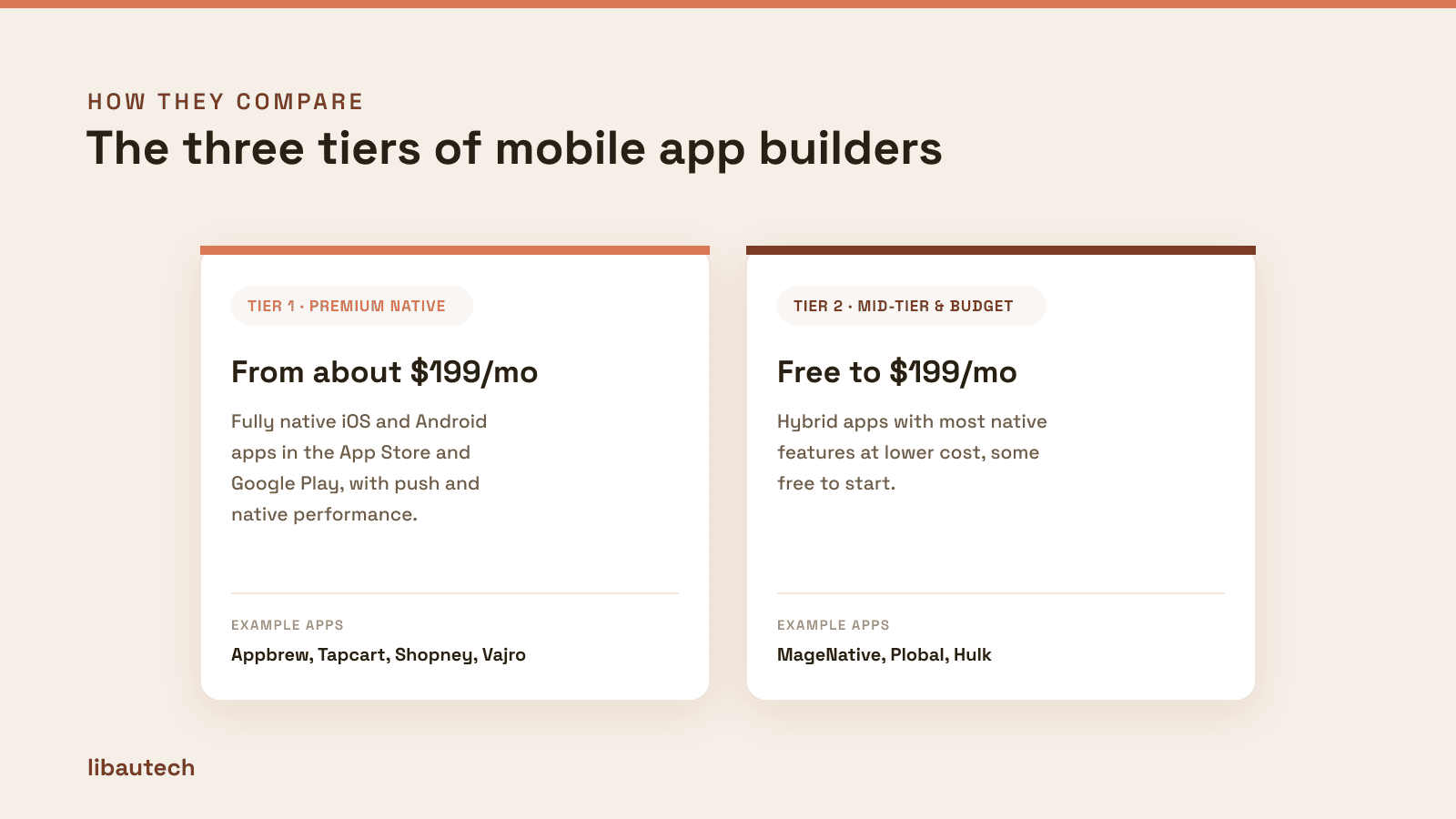
The honest framing: Shopify mobile app builders break into two distinct tiers. Most stores need exactly one based on actual revenue scale and customer base maturity — picking the wrong tier either over-pays for native capabilities the customer base doesn't justify or under-delivers on the actual repeat-purchase economics.
The first tier is premium native iOS/Android app platforms — fully-native apps deployed to Apple App Store and Google Play with push notifications, biometric authentication, native checkout integration, deep theme customization, and full mobile platform feature access. The mechanics: app builder generates native iOS (Swift) and Android (Kotlin) apps from Shopify catalog, handles App Store submission, manages ongoing updates and platform policy compliance. Appbrew, Tapcart, Shopney, and Vajro lead this tier. The right pick for established stores at $100K+ monthly revenue with mature customer bases.
The second tier is mid-tier and budget app builders — hybrid native apps (typically using Cordova, Capacitor, or React Native) wrapped around web content with native shell features, push notifications, and App Store deployment at meaningfully lower entry pricing. Different mechanics from premium platforms: web content rendered in a native WebView wrapper rather than fully-native UI. MageNative, Plobal Apps, and Hulk Mobile App Builder lead this tier. The right pick for stores wanting native app deployment without premium platform pricing.
This post ranks 7 apps across the two tiers based on verified April 2026 Shopify App Store data and what each one actually solves.
Mobile app builders stack with broader mobile and storefront tools. See our guides on best Shopify navigation apps for the related mobile-first navigation layer that complements both web and app experiences, best Shopify web push apps for the related browser-based push notification layer that competes with native app push, and best Shopify design customization apps for the related theme customization layer that intersects with mobile UX.
Quick Comparison: 7 Best Shopify Mobile App Builders (2026)
| App | Rating | Free Plan | Paid From | Tier | Best For |
|---|---|---|---|---|---|
| Appbrew | ⭐ 5.0 (67) | Free plan | $199/mo | Native premium | Polished native apps, launched fast |
| Tapcart | ⭐ 4.8 (400+) | Free trial | $200/mo | Native premium | Most-installed native platform, established brands |
| Shopney | ⭐ 5.0 (1,142) | Free trial | $249/mo | Native premium | 5.0-star rating, multi-language, global market focus |
| Vajro | ⭐ 4.8 (1,800+) | Free trial | $199/mo | Native premium | Live video shopping integration, broad customization |
| MageNative Mobile App Builder | ⭐ 4.8 (320) | Free trial | $99/mo | Mid-tier hybrid | Affordable native deployment, broad merchant adoption |
| Plobal Apps Mobile App Builder | ⭐ 4.8 (142) | Free trial | $199/mo | Mid-tier hybrid | No-code builder, automated push campaigns |
| Hulk Mobile App Builder | ⭐ 4.8 (71) | Yes | $79/mo | PWA | Hulk ecosystem integration, PWA + hybrid options |
Tier 1: Premium Native iOS/Android App Platforms
This tier is for established Shopify stores at $100K+ monthly revenue with mature customer bases ready for native app deployment. The mechanics: platform generates fully-native iOS (Swift) and Android (Kotlin) apps from Shopify catalog, handles App Store submission and ongoing updates, manages platform policy compliance. Three apps lead this tier.
1. Appbrew
Best for: Shopify stores with a repeat-purchase base wanting a fully-native iOS and Android app their marketing team can operate without dev tickets, with an AI agent handling push copy, campaign setup, and per-shopper personalization — the AI-native premium pick.

Appbrew is a premium native app builder that turns your Shopify store into full iOS and Android apps, with push notifications and no-code theming. It holds 5.0 stars across 67 reviews, 100% of them 5-star, the highest rating in the premium native tier, and carries the Built for Shopify badge. The positioning is native app deployment run by marketers rather than developers: drag-and-drop screen building with real-time preview, launch drops and swap banners without a release cycle, and real-time Shopify catalog sync.
The differentiating positioning is Milo, an AI app agent built into the platform: it writes push notification copy, assembles campaigns, generates layout blocks, and personalizes the home screen and offers per individual shopper. This matters specifically for stores without a dedicated mobile marketing headcount; Appbrew's agent drafts the campaign and the targeting for you. Push is unlimited on every paid tier rather than metered.
Core features: native iOS and Android apps with App Store and Play Store launch handling; drag-and-drop editor with real-time preview and real-time catalog sync; Milo AI agent for push copy, campaign building, and block generation; AI-powered per-shopper personalization; unlimited push notifications with segments, geolocation, back-in-stock, abandoned cart, scheduled, and rich media; native video shopping module; in-app search, wishlists, size charts, and swatches; A/B testing; gifting and bundle flows; native subscription management; global multi-currency and multi-language; 120+ integrations including Klaviyo, Yotpo, ReCharge, Stamped, Facebook SDK, and Google Analytics; Shopify Checkout and Customer Accounts extensions; conversion and performance analytics.
Where it falls short: smaller review base than Tapcart, Shopney, and Vajro, at just 67 reviews, so less merchant-verified track record at scale despite the perfect rating. Starter pricing carries additional usage-based charges tied to app performance, so total cost rises with volume rather than staying flat. Custom app design and dedicated customer success sit on the Enterprise tier.
Pricing: Free plan available with a 30-day free trial. Starter $199/mo, Pro $599/mo, custom pricing for Enterprise.
2. Tapcart
Best for: established Shopify stores at $250K+ monthly revenue wanting the most-installed premium native app platform with deep customization, advanced merchandising, and broad enterprise feature set — the established native app pick for serious mobile commerce investment.
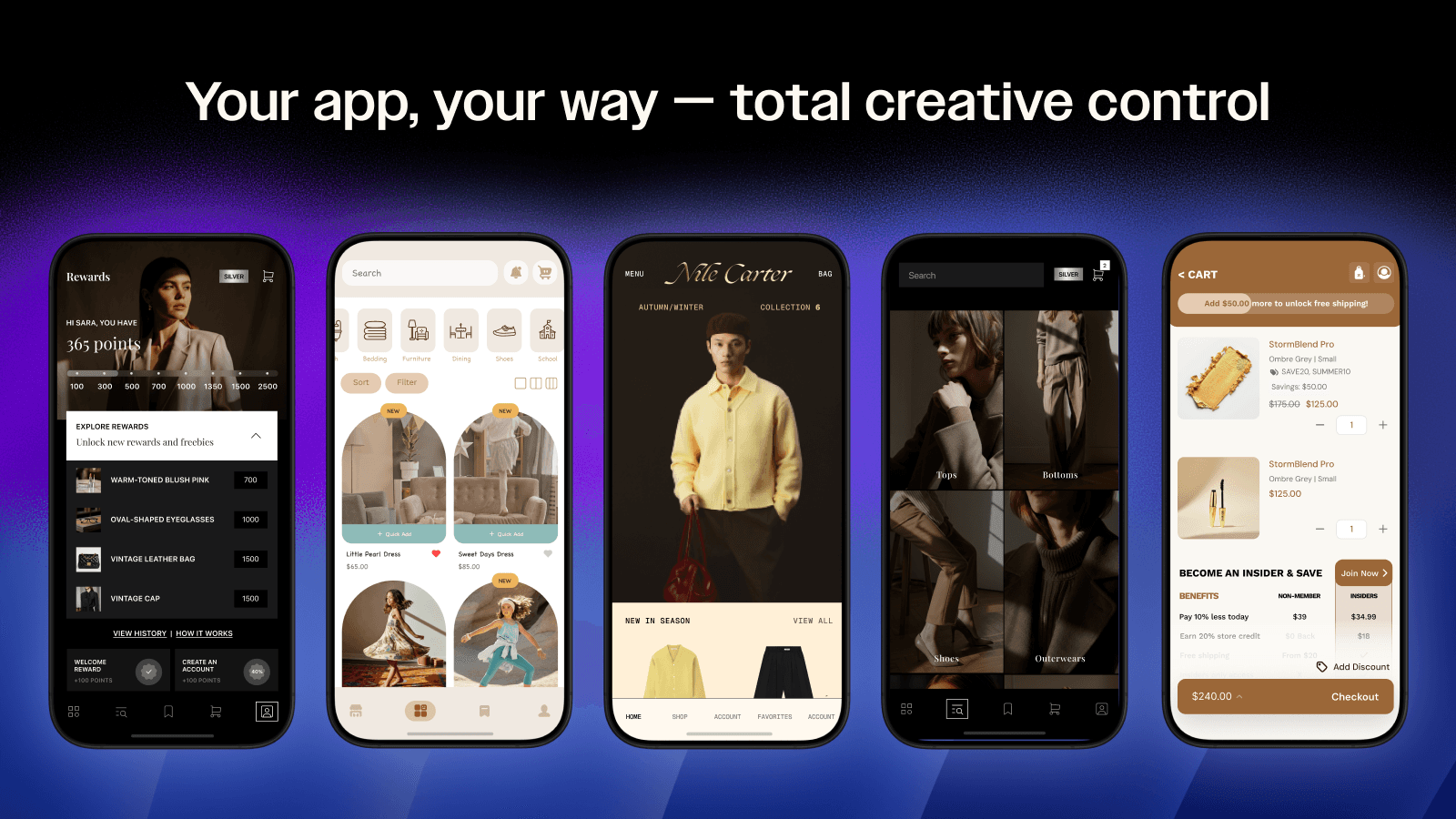
Tapcart holds 4.8 stars across 400+ reviews — the most-installed premium native app builder on Shopify. The positioning is comprehensive native app infrastructure: drag-and-drop builder for non-technical merchants, real-time Shopify catalog synchronization, native iOS and Android deployment with App Store handling, push notifications with segment-based targeting (notify wholesale customers different from retail, geo-targeted notifications, behavior-based triggers), advanced merchandising with native UI components, biometric authentication for repeat purchases, and comprehensive analytics on app engagement and conversion.
The push notification segmentation matters specifically for mature customer bases. Stores with 5,000+ app users benefit dramatically from segmented push ("new arrivals for VIP customers," "flash sale for inactive users," "abandoned cart for last-7-day visitors") rather than blast-to-all approaches — segmented push typically delivers 2-3x conversion rates versus untargeted notifications. For stores at scale, this segmentation compounds across millions of monthly notifications.
Core features: drag-and-drop native app builder; real-time Shopify catalog sync; native iOS and Android deployment with App Store submission handling; segmented push notifications with behavior-based triggers; biometric authentication; advanced merchandising with native UI components; A/B testing for app variants; comprehensive analytics on engagement and conversion; integration with Klaviyo, Yotpo, and major Shopify ecosystem apps; Built for Shopify certification.
Where it falls short: pricing entry point ($200/mo) is the highest in the category, and enterprise tiers exceed $1,000/mo for high-volume stores. Setup complexity is real for stores configuring advanced merchandising and segmentation. Best for established brands with mature mobile commerce strategy rather than stores experimenting with native apps.
Pricing: Free trial. Paid plans from $200/mo.
3. Shopney
Best for: Shopify stores wanting 5.0-star-rated premium native app platform with multi-language support, global market focus, and comprehensive enterprise features — the international native app pick.
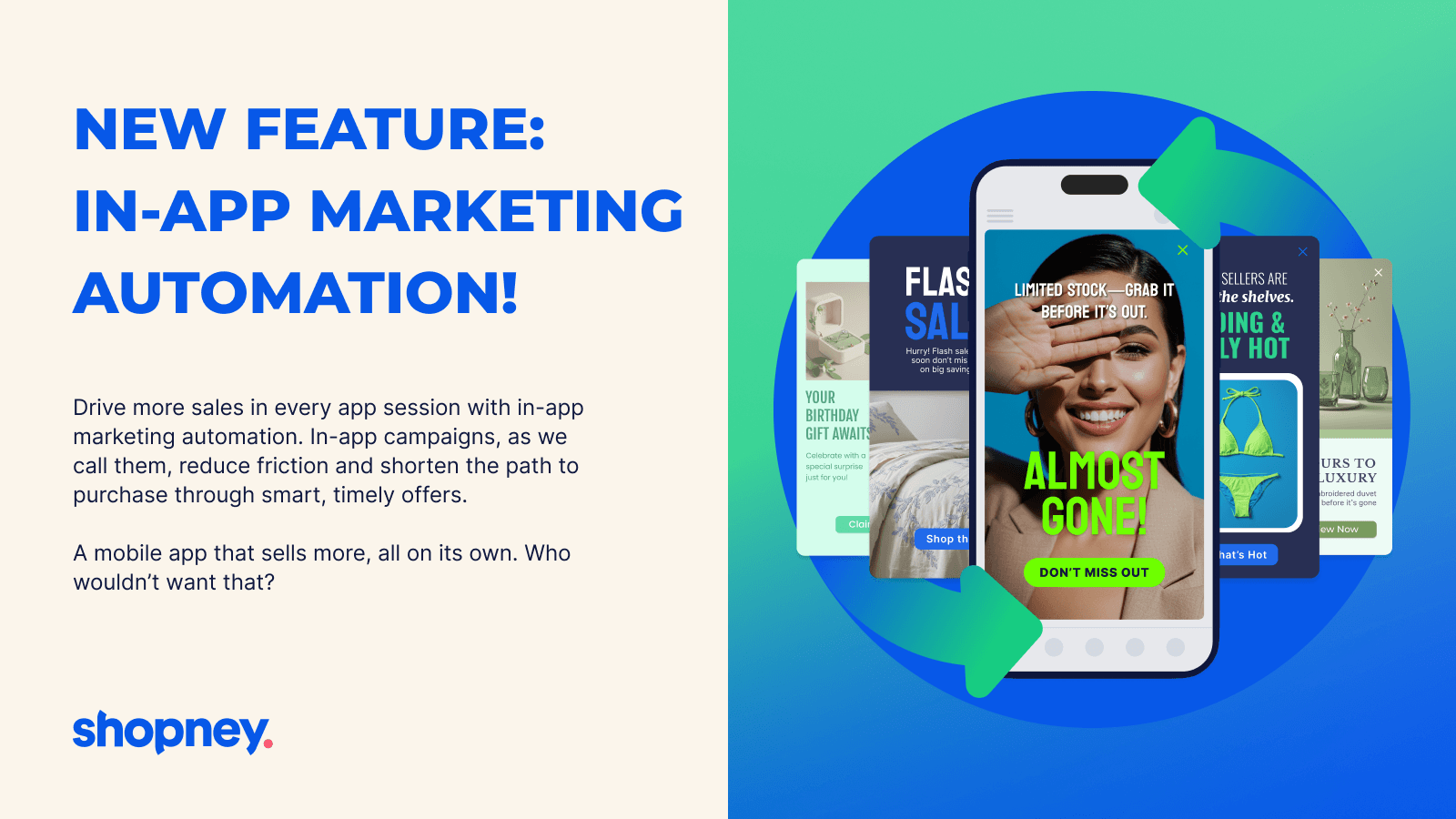
Shopney holds 5.0 stars across 1,142 reviews — the highest-rated premium native app platform with the largest review base in the tier. The positioning is comprehensive native app deployment with strong international focus: multi-language support across 60+ languages with localization tools (currency, tax, shipping rates per region), cross-platform native iOS and Android apps with feature parity, push notifications with multi-language template support, advanced theme customization matching brand identity, and white-glove app submission service handling Apple App Store and Google Play approval.
The international focus matters specifically for global stores. Native apps deployed across multiple language markets typically require separate app variants per language for App Store optimization (different keywords, descriptions, screenshots per market). Shopney's multi-language framework handles this through one underlying app with localized presentation per market — reducing the operational overhead of managing multiple market deployments.
Core features: native iOS and Android apps with feature parity; multi-language support across 60+ languages; localization tools for currency, tax, shipping per region; push notifications with multi-language templates; advanced theme customization; white-glove App Store submission service; integration with Shopify Markets; comprehensive analytics; Built for Shopify certification.
Where it falls short: pricing entry point ($249/mo) higher than Tapcart and Vajro for stores not requiring international features. Setup complexity moderate for stores configuring multi-language workflows. Best for stores serving multiple language markets rather than single-language operations.
Pricing: Free trial. Paid plans from $249/mo.
4. Vajro
Best for: Shopify stores wanting native app deployment with live video shopping integration, broad customization, and competitive pricing — the live commerce-focused native app pick.

Vajro holds 4.8 stars across 1,800+ reviews — the largest review base in the premium native tier. The differentiating positioning is live video shopping integration: native app includes live video streaming infrastructure for hosting interactive shopping events directly in the app, real-time customer engagement with chat and reactions during streams, immediate purchase functionality during live streams, and integration with major social platforms for cross-promotion.
The live video positioning matters specifically for brands with influencer or community-driven sales. Live shopping (popularized in Asian markets, growing rapidly in Western markets) typically drives 5-10x conversion rates versus standard product listings during active streams. Vajro's native integration handles streaming infrastructure that would otherwise require third-party platforms (StreamYard, Bambuser) plus integration overhead.
Core features: native iOS and Android apps; live video shopping with in-app streaming; real-time chat and reactions during streams; immediate purchase functionality during live events; brand-focused design tools with theme customization; push notifications; integration with Shopify catalog and customer data; analytics on live commerce performance.
Where it falls short: live video shopping requires meaningful operational investment (planning streams, hosting talent, post-stream marketing) that not all stores want. Less polished international features than Shopney. Best for brands committed to live commerce as a primary sales channel rather than stores wanting standard native apps.
Pricing: Free trial. Paid plans from $199/mo.
The Honest Trade-Off: Most Stores Don't Need Native Apps
Worth saying explicitly: most Shopify stores don't need a native mobile app. Mobile-optimized Shopify storefronts handle 60-70% of mobile shopping needs natively — customers can browse, search, add to cart, and check out from any modern Shopify theme on mobile without app installation. Native apps add value through specific mechanics (push notifications, persistent app icon, biometric authentication, app-only deals) that earn their cost only when stores have meaningful repeat-purchase patterns and customer base scale.
The repeat-purchase economics matter specifically. Native apps drive 30-50% repeat purchase rate versus 5-10% on mobile web for stores with mature customer bases. The math: a store with 1,000 monthly customers and $80 average order value sees roughly $4,000-8,000 monthly repeat revenue from native app users versus $400-800 from mobile web. The repeat-rate lift comes from push notifications (90%+ open rate vs 20-25% email open rate) plus the persistent app icon on customer phones.
The signal that native apps earn their cost: existing customer base of 5,000+ active monthly users (the people who would actually install the app), repeat-purchase rate already meaningful on web (10%+ of customers return monthly), and revenue scale supporting $200-500/mo investment ($100K+ monthly revenue typically). The signal that native apps are premature: smaller customer base, predominantly first-time buyers, or revenue under $50K monthly where app subscription consumes meaningful margin without proportional repeat-purchase upside.
Tier 2: Mid-Tier and Budget App Builders
This tier is for stores wanting native app deployment without premium platform pricing. The mechanics: hybrid native apps (typically using Cordova, Capacitor, or React Native) wrapped around web content with native shell features, push notifications, and App Store deployment. Different mechanics from premium tier: web content rendered in a native WebView wrapper rather than fully-native UI components. Three apps lead this tier.
5. MageNative Mobile App Builder
Best for: Shopify stores wanting affordable native app deployment with broad merchant adoption and integration with major Shopify ecosystem apps — the established mid-tier native app pick at meaningfully accessible pricing.

MageNative Mobile App Builder holds 4.8 stars across 320 reviews — the largest review base in the mid-tier hybrid layer. The positioning is comprehensive native app deployment at meaningfully lower entry pricing ($99/mo): drag-and-drop builder, native iOS and Android apps deployed to App Stores, push notifications with segmentation, integration with major Shopify apps (Klaviyo, Yotpo, Recharge, Loyalty Lion), biometric authentication, and live chat support.
The pricing positioning matters specifically. MageNative's $99/mo entry tier is meaningfully lower than Tapcart's $200/mo or Shopney's $249/mo, making native app functionality accessible to stores at $30-100K monthly revenue that wouldn't qualify for premium platform pricing. For mid-sized stores wanting to test native app deployment before scaling to enterprise platforms, MageNative covers the use case at proportionally appropriate investment.
Core features: drag-and-drop native app builder; native iOS and Android deployment; push notifications with segmentation; integration with Klaviyo, Yotpo, Recharge, Loyalty Lion, and major Shopify ecosystem apps; biometric authentication; live chat support; analytics dashboard; integration with Shopify Online Store 2.0 themes.
Where it falls short: less polished UI than Tapcart's premium experience. Smaller installed base of high-volume merchants — less proven at $1M+ monthly revenue scale. Some merchant reviews flag occasional sync delays during high-volume catalog updates. Best for mid-sized stores rather than enterprise-scale operations.
Pricing: Free trial. Paid plans from $99/mo.
6. Plobal Apps Mobile App Builder
Best for: Shopify stores wanting no-code native app deployment with automated push notification campaigns and broad merchant adoption — the marketing-focused mid-tier native app pick.
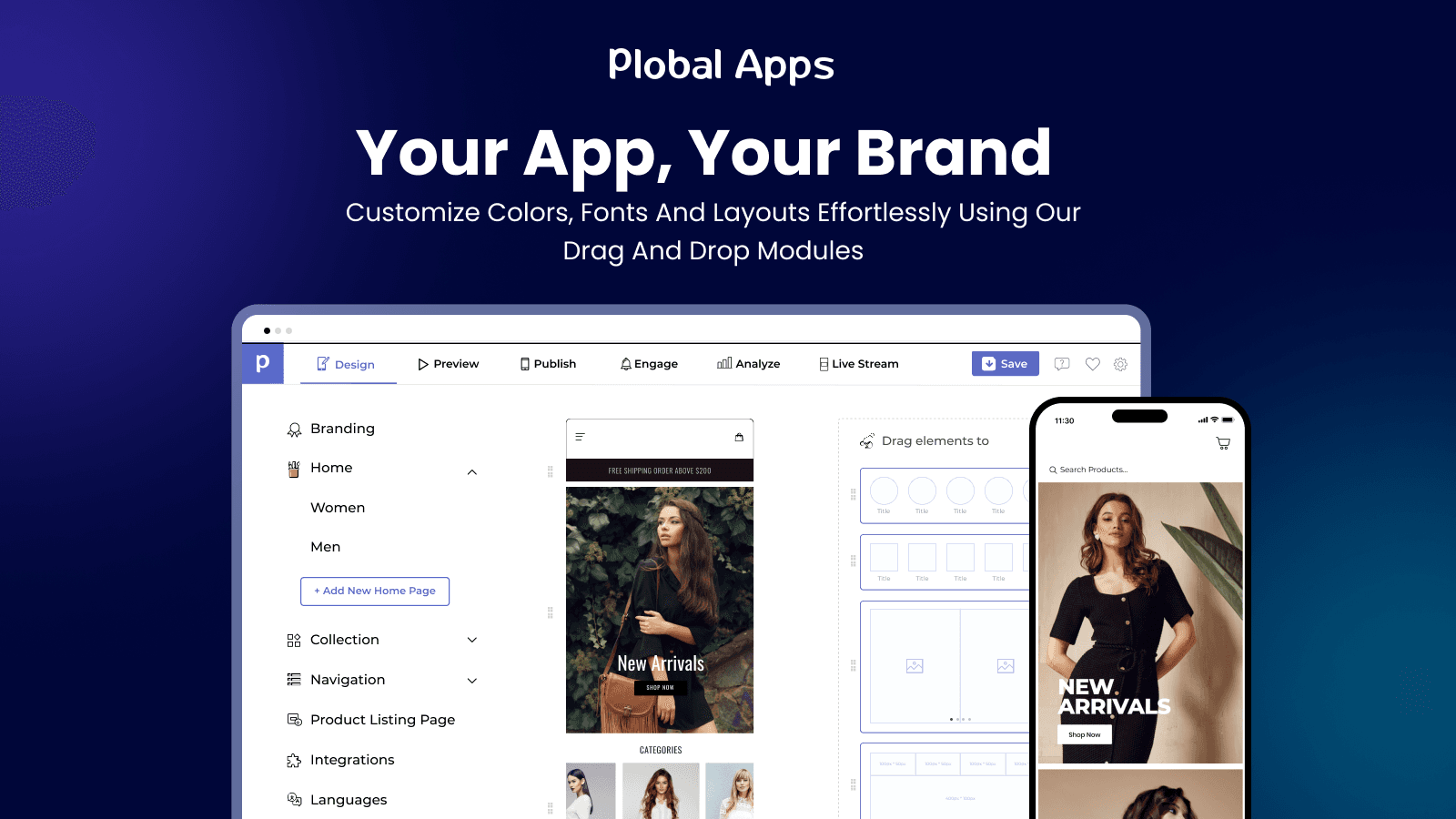
Plobal Apps Mobile App Builder holds 4.8 stars across 142 reviews. The differentiating positioning is automated marketing campaigns within the native app: native iOS and Android apps, automated push notification campaigns based on customer behavior (abandoned cart, post-purchase, win-back), pre-built marketing flows with template library, integration with Shopify customer segments, and analytics on campaign performance.
The automated marketing matters specifically for stores with limited marketing operations. Where Tapcart requires merchants to configure push notification segments manually, Plobal's pre-built campaign templates handle common marketing scenarios (cart abandonment recovery, post-purchase upsell, 30-day win-back) without manual setup — useful for stores wanting native app benefits without dedicated mobile marketing resources.
Core features: no-code native app builder; native iOS and Android deployment; automated push notification campaigns with pre-built flows; behavior-triggered notifications; template library for common marketing scenarios; integration with Shopify customer segments; campaign analytics; integration with Shopify Online Store 2.0 themes.
Where it falls short: pricing entry point ($199/mo) higher than MageNative's $99/mo for stores not using automated marketing features. Smaller installed base than premium tier alternatives. Best for marketing-led mid-sized stores rather than design-led brands.
Pricing: Free trial. Paid plans from $199/mo.
7. Hulk Mobile App Builder
Best for: Shopify stores already using Hulk's broader app ecosystem wanting bundled mobile app functionality with PWA and hybrid options — the bundled-platform pick.
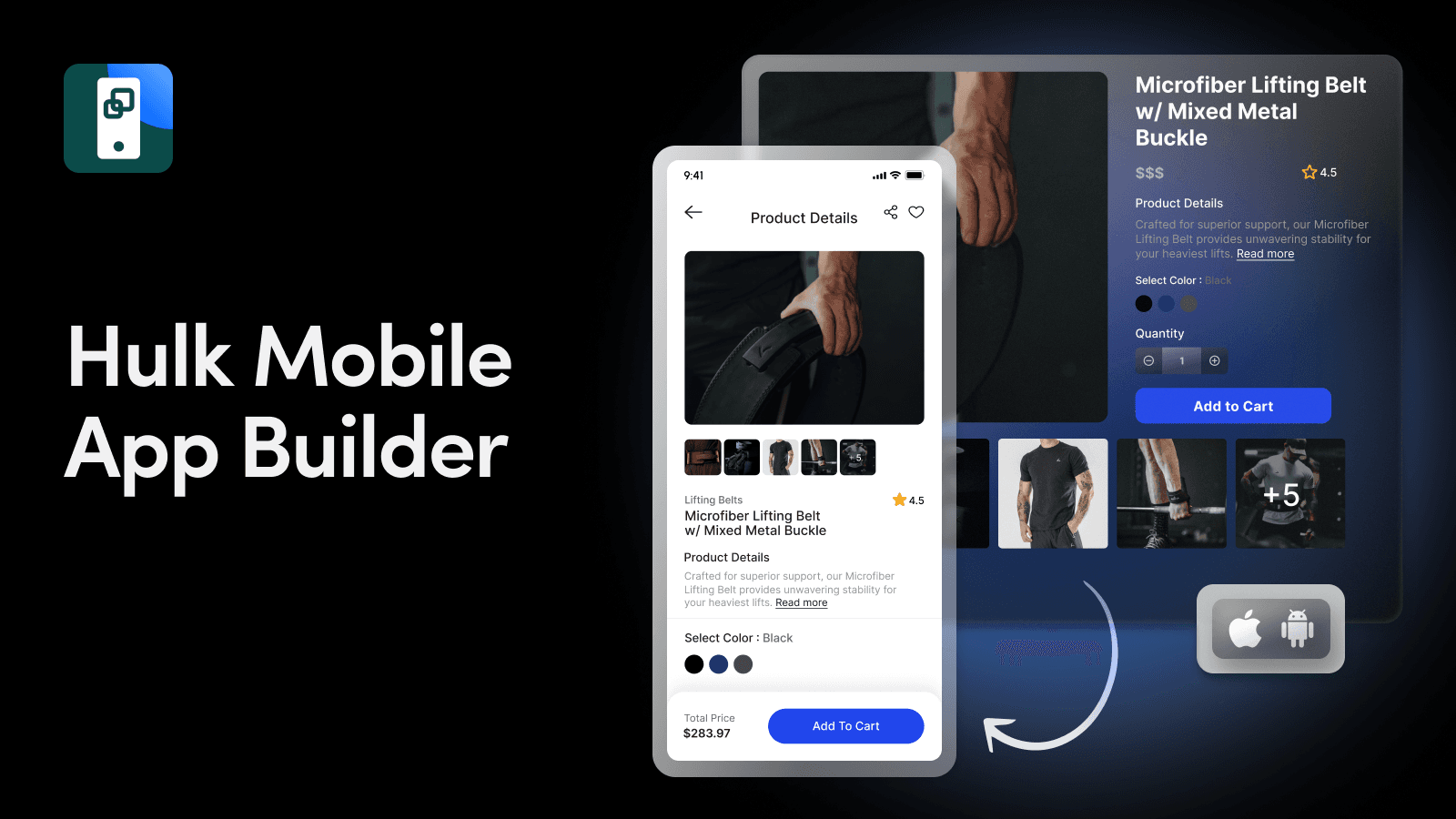
Hulk Mobile App Builder holds 4.8 stars across 71 reviews. The differentiating positioning is bundled functionality with Hulk's broader Shopify ecosystem (Hulk Form Builder, Hulk Product Options, Hulk Order Status Tracker): mobile app deployment with both PWA and hybrid native options, integration with other Hulk apps for unified merchant experience, push notifications, customizable themes, and consolidated billing across multiple Hulk subscriptions.
The Hulk ecosystem advantage matters specifically for stores already using multiple Hulk apps. Consolidated vendor relationships across multiple essential apps simplify operations and often unlock bundled discounts versus separate vendor relationships per category. For stores already invested in Hulk's broader platform, the mobile app layer adds capability under the existing relationship.
Core features: PWA and hybrid native app deployment; integration with Hulk's broader app ecosystem; push notifications; customizable themes; integration with Shopify Online Store 2.0 themes; merchant dashboard with mobile analytics; consolidated billing across Hulk subscriptions.
Where it falls short: less specialized than dedicated mobile app builders — feature depth narrower than Tapcart on native. Best for stores already committed to Hulk's broader ecosystem rather than standalone mobile deployments.
Pricing: Free plan available. Paid plans from $79/mo.
Which Mobile App Builder to Choose
For the highest-rated native platform with no-code theming and push notifications: Appbrew. 5.0 stars, 67 reviews, $199/mo entry and the Built for Shopify badge, the top-rated native pick for stores scaling repeat purchases.
For most-installed premium native platform with deep customization and enterprise features: Tapcart. 4.8 stars, 400+ reviews, $200/mo entry, the established premium pick for stores at $250K+ monthly revenue.
For 5.0-star native platform with multi-language and global market focus: Shopney. 5.0 stars, 1,142 reviews, $249/mo entry, the international native pick.
For native app deployment with live video shopping integration: Vajro. 4.8 stars, 1,800+ reviews, $199/mo entry, the live commerce-focused native pick.
For affordable native deployment with broad merchant adoption: MageNative Mobile App Builder. 4.8 stars, 320 reviews, $99/mo entry, the budget-friendly mid-tier pick for $30-100K monthly revenue stores.
For no-code native app deployment with automated push campaigns: Plobal Apps Mobile App Builder. 4.8 stars, $199/mo, the marketing-focused mid-tier pick.
For Hulk ecosystem customers wanting bundled mobile app: Hulk Mobile App Builder. 4.8 stars, $79/mo, the bundled-platform pick.
For most Shopify stores in this category, the honest framing is revenue-scale-first. Stores under $50K monthly revenue typically don't justify native app investment — mobile-optimized Shopify storefront plus a budget app builder like Hulk deliver more revenue per dollar than premium native platforms. Stores at $50-150K monthly revenue can validate native deployment with mid-tier hybrid builders (MageNative at $99/mo). Stores at $150K+ monthly revenue with mature customer bases install premium native platforms (Tapcart, Shopney, Vajro). The most common mobile app mistake is installing Tapcart's $300/mo Pro tier on a $30K monthly revenue store — native apps drive their value through repeat-purchase economics that require meaningful customer base scale to earn back the subscription.
How We Ranked These Apps
This ranking is based on four criteria applied to every Shopify mobile app builder tested in 2026. First, Shopify App Store rating and verified review volume as of April 30, 2026 — the strongest signal of long-term merchant satisfaction at scale. Second, fit-to-tier for which of the two tiers each app actually solves (premium native, mid-tier hybrid, or PWA) rather than treating these as a single category. Third, pricing structure and total cost at realistic merchant volumes — a $19.90/mo PWA tool and a $300/mo premium native platform handle different scopes, and the math depends on which tier the store actually needs based on revenue scale and customer base maturity. Fourth, deployment overhead fit, since merchant satisfaction depends on whether the app's deployment complexity matches operational reality (white-glove submission for stores without internal resources, self-serve builders for technical merchants).
Every pricing and feature figure in this post was verified directly from each app's live Shopify App Store listing on April 30, 2026. App pricing structures change — always confirm current pricing on the official listing before installing. Ratings and review counts reflect the Shopify App Store at the time of our last update.
Frequently Asked Questions
What is a Shopify mobile app builder?
A Shopify mobile app builder handles one of two distinct tiers. Premium native iOS/Android platforms (Tapcart, Shopney, Vajro) deliver fully-native apps deployed to Apple App Store and Google Play with push notifications and full mobile platform integration. Mid-tier hybrid builders (MageNative, Plobal Apps, Hulk Mobile App Builder) deliver hybrid native apps at lower entry pricing.
What is the best Shopify mobile app builder in 2026?
Depends on the tier and revenue scale. For premium native: Appbrew (5.0 stars, $199/mo entry, Built for Shopify), Tapcart (4.8 stars, $200/mo entry, most-installed), Shopney (5.0 stars, multi-language), or Vajro (live video shopping). For mid-tier and budget: MageNative ($99/mo, broad adoption), Plobal Apps ($199/mo, automated marketing), or Hulk Mobile App Builder ($79/mo, free plan to start). Pick the tier first based on revenue scale.
How much do Shopify mobile app builders cost?
Entry tiers range from free (PWA tools and some hybrid builders) to $19.90-49/mo for PWA and budget hybrid options. Mid-tier hybrid platforms run $49-199/mo. Premium native platforms run $200-500/mo on entry tiers, with enterprise tiers exceeding $1,000/mo for high-volume stores. The right pick costs less than $100/mo for most stores under $200K monthly revenue.
Do I need a native mobile app for my Shopify store?
Most stores don't. Mobile-optimized Shopify storefronts handle 60-70% of mobile shopping needs natively. Native apps earn their cost when stores have repeat-purchase patterns where push notifications drive retention (push converts 2-3x higher than email), meaningful catalog scale ($100K+ monthly revenue), and existing customer base willing to install another app. Premature native app investment is a common $3,000-6,000 annual mistake.
What is the difference between native apps and PWAs?
Different mechanics solving similar customer-facing experience. Native apps run as fully-native iOS (Swift) and Android (Kotlin) apps with App Store deployment, push notifications on both platforms, and persistent app icons. PWAs run as enhanced web pages with manifest.json and service workers, home screen installation, offline support, and push notifications on Android (limited iOS Safari support). Native apps deliver better performance and feature access; PWAs deliver app-like UX without App Store overhead.
How much do native apps lift repeat purchases?
30-50% repeat purchase rate versus 5-10% on mobile web for stores with mature customer bases. The math: a store with 1,000 monthly customers and $80 average order value sees roughly $4,000-8,000 monthly repeat revenue from native app users versus $400-800 from mobile web. The repeat-rate lift comes from push notifications (90%+ open rate vs 20-25% email open rate) plus the persistent app icon on customer phones.
What are App Store fees and policy requirements?
Apple Developer Program ($99/year), Google Play Console ($25 one-time), App Store Review Guidelines compliance, and ongoing policy updates. Apple charges 30% on in-app digital goods purchases (15% for small developers under $1M annual revenue). App Tracking Transparency disclosures and privacy nutrition labels required. PWAs and mobile-optimized storefronts skip all this overhead.
Should I install Tapcart or MageNative?
Depends on revenue scale. If you want the highest-rated native app, Appbrew (5.0 stars, $199/mo, Built for Shopify) leads on quality. Stores at $250K+ monthly revenue with mature customer bases install Tapcart ($200/mo) for premium native features and broad enterprise capabilities. Stores at $30-150K monthly revenue install MageNative ($99/mo) for native deployment without premium pricing — covers core features at quarter the cost. The Tapcart investment doesn't earn back on smaller stores; the MageNative feature set ceiling matters less for stores still validating mobile app strategy.
Will mobile app builders slow down my Shopify storefront?
Native apps don't affect Shopify storefront performance — they're separate apps deployed to App Stores rather than integrated with the web storefront. PWA tools add manifest.json and service worker JavaScript to the storefront, with measurable but small impact on initial page load. Always test page speed before and after PWA install with Google PageSpeed Insights to confirm impact on your specific theme.
How long does App Store approval take?
Typically 1-2 weeks for first submission with established mobile app builders that have submission expertise. First-time submissions from new builders often face 2-4 week cycles with rejections for policy compliance issues (privacy disclosures, App Tracking Transparency, in-app purchase rules). White-glove services like Shopney handle submission and rejection cycles as part of the subscription — reducing internal operational overhead during initial deployment.
Think Your App Belongs on This List?
We update these lists as new tools launch and existing ones improve. If you are a developer building a Shopify mobile app builder, native app platform, or PWA tool and want your app considered for inclusion, submit it here — tell us what your app does, who it is for, and include a link to your Shopify App Store listing. We review every submission.